

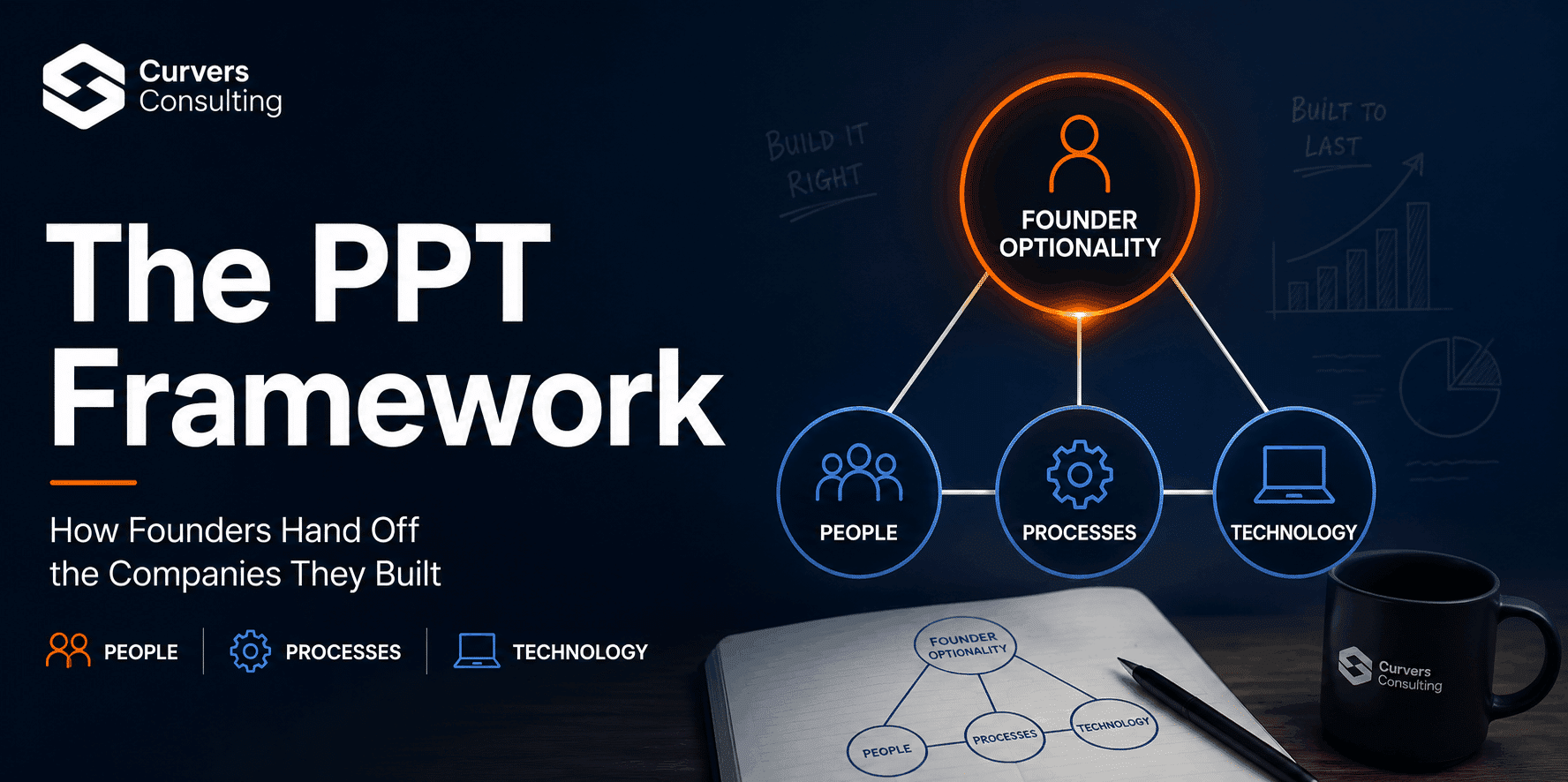
Most founders don't struggle to grow their companies. They struggle to grow them without themselves at the center. The PPT Framework—People, Processes, and Technology—is the system I learned while building and exiting Polysleep. It's what allows a founder-led company to become an operator-led business that can survive a transition, acquisition, or exit.
The PPT Framework: How Founders Actually Hand Off the Companies They Built
The day I looked at the Polysleep org chart and admitted that the people who built the company weren’t the people who would run it, I felt sick about it. We’d survived the first three years on a team of Swiss-knife operators — talented generalists doing seven things badly enough to keep the lights on, and one thing brilliantly enough to keep us alive. That team got us through the hardest stage of the business.
By year four, they’d become the bottleneck. Not because they weren’t good, but because the company had changed and they hadn’t signed up for the company it was becoming. What got us from zero to millions in revenue was never going to get us to the next stage, and if I wanted the business to run without me at the center of it, I needed a different structure. This is the post about what comes after that realization.
Most founders don’t fail at scaling. They fail at scaling without themselves. The company outgrows the founder’s bandwidth long before the founder builds a structure that can run without them, and the result isn’t a revenue ceiling — it’s an optionality ceiling. You can’t take a real vacation, step into a board seat, or sell with any confidence. You can’t even disappear for a month without finding out how much of the business has been living inside your head the entire time.
I learned that the hard way at Polysleep. The framework that eventually moved me from founder-led operator to executive wasn’t complicated: People, Processes, and Technology. Not as a generic business framework — as a founder transition framework. Each leg exists because I paid for not having it first. (The People leg, in particular, picks up where an earlier piece left off: founder-led marketing has roughly a 24-month shelf life, and the same logic applies to the founder-led everything.)
People: The Team That Built It Isn’t the Team That Runs It
For the first few years at Polysleep, we couldn’t afford specialization. Sales were growing, but not fast enough to support a properly structured organization, so we operated the way most founder-led businesses do. My first hire was a self-proclaimed COO. A senior graphic designer was also doing our web development. Two talented digital marketers spent half their energy fighting each other over the same decisions. Everyone was talented, everyone was committed, and everyone wore four hats badly — because there was no other option.
That environment worked because chaos was still productive; the company needed flexibility far more than it needed clarity. Then the business matured. Marketing got more sophisticated, customer acquisition got more expensive, content needs exploded, and suddenly someone actually had to own each function. So we built a real structure: Marketing Director, Graphic Designer, Videographer, Social Media Manager, Affiliate Manager.
And as we introduced specialization, the thing most founders won’t talk about happened. The people who had helped build the company struggled inside the company we were becoming. We parted ways with the COO. Eventually, none of the original Swiss-knife operators remained — not because they weren’t capable, but because they’d thrived in exactly the environment we were deliberately leaving behind.
Most founders delay these decisions because loyalty feels more important than org design. I understand that instinct; I’ve lived it. But a founder who can’t transition the original team usually can’t transition out of the company. The first employee who got you to $5 million is rarely the executive who gets you to $20 million. Your job as the founder was never to preserve yesterday’s structure. It’s to build tomorrow’s.

How Do You Scale a Company Without the Founder? Start With Processes.
When you start a company, everything feels urgent — inventory, customer support, cash flow, marketing performance, all of it screaming at once. The problem is that urgency crowds out everything that’s important but not urgent, and documentation is always the thing that becomes tomorrow’s problem.
At Polysleep, I didn’t document how we built the Shopify store. I didn’t document our Gorgias workflows, the ShipStation and UPS integrations, the provincial tax adjustments, or any of the operational logic that felt obvious to me because I’d been living inside it for years. The business ran fine because I knew how every piece connected. Then I started delegating, and I learned that handing someone a task isn’t the same as transferring the knowledge behind it.
Over six months, we cycled through three Operations Directors. Each one spent their first weeks trying to reverse-engineer decisions that already existed inside the business but had never been written down. We lost thousands of dollars in shipping costs alone — packages that should have been bundled went out separately, and packages that should have shipped separately went out bundled. Not because anyone was incompetent. Because the blueprint didn’t exist.
The lesson wasn’t about operations. It was about replication. If a task is repetitive, document it. If a decision gets made the same way twice, document it. If only one person knows how something works, that isn’t job security — it’s a liability, so document it. Every SOP you write makes the company worth more, because it makes the company less dependent on any single person. Founders tend to think delegation starts when someone new is hired. It actually starts the moment a process becomes repeatable — by the time you’re hiring, the documentation should already be sitting there waiting for them.
What Is the PPT Framework’s Technology Layer?
One of the biggest mistakes I made at Polysleep came from watching Casper. They were the giant, we were the challenger, and I assumed their internal dev team was bigger than my entire company. So whenever Casper shipped something that looked smart, I paid attention — sometimes too much attention.
Friendbuy is the example I think about most. The referral platform looked brilliant on paper: customers refer friends, friends buy, everyone wins. We put thousands of dollars and hundreds of hours into implementing it — adjusting offers, testing structures, optimizing the workflows. Months later the verdict was obvious. Friendbuy wasn’t generating enough genuinely new customers to justify any of it. In most cases we were just paying for referrals that would have happened anyway, because our product, our customer experience, and our brand were already doing that work. The platform became a tax we paid for the privilege of looking sophisticated.
That experience permanently changed how I evaluate technology. Most founders judge software on features. I started judging it on future operators. Can the next leader actually run this? Can someone inherit the system without needing the person who built it? Will this tool still make sense eighteen months from now? The best stack isn’t the most powerful one — it’s the one that survives a leadership transition. When you build technology around yourself, you create dependency. When you build it around operators, you create transferability. And transferability is the thing buyers, investors, and future executives actually pay for.

Where the PPT Framework Breaks
PPT is dangerous if you apply it too early. Before product-market fit, structure can hurt more than it helps — documentation curdles into bureaucracy, specialized hires create overhead you can’t afford, and operator-friendly software is often less effective than the scrappy workaround a founder built at midnight. In the early years, Swiss-knife operators are exactly what most businesses need. That’s the entire point.
This is a founder transition framework, and it only earns its keep when the company approaches the handoff stage — the inflection point where the business has to evolve from founder-led to operator-led. Apply it too early and you’ll burn cash, slow every decision, and frustrate the people keeping the company alive. Apply it too late and you’ll wake up to a business that can’t function without you. Neither one is a good place to be. Timing is the whole game.
Monday Morning Takeaway
Run a PPT audit this week, and start with your weakest leg. If it’s People, draw the org chart you’d build if you were hiring from scratch today and hold it up against the one you actually have. If it’s Processes, find one recurring task only you can do and write the SOP before Friday. If it’s Technology, list every tool in your stack and ask one question of each: could the next operator run this without me?
People, Processes, and Technology reinforce each other — strengthen one and the next gets easier; ignore one and founder dependency quietly survives. The goal was never growth for its own sake. The goal is transferability. Because the moment you can actually hand off the company is the moment you finally own it, instead of it owning you.
If you’re a founder approaching that bottleneck moment — when the company has outgrown the team that built it — I take on a small number of advisory engagements each year. Reach out.
