

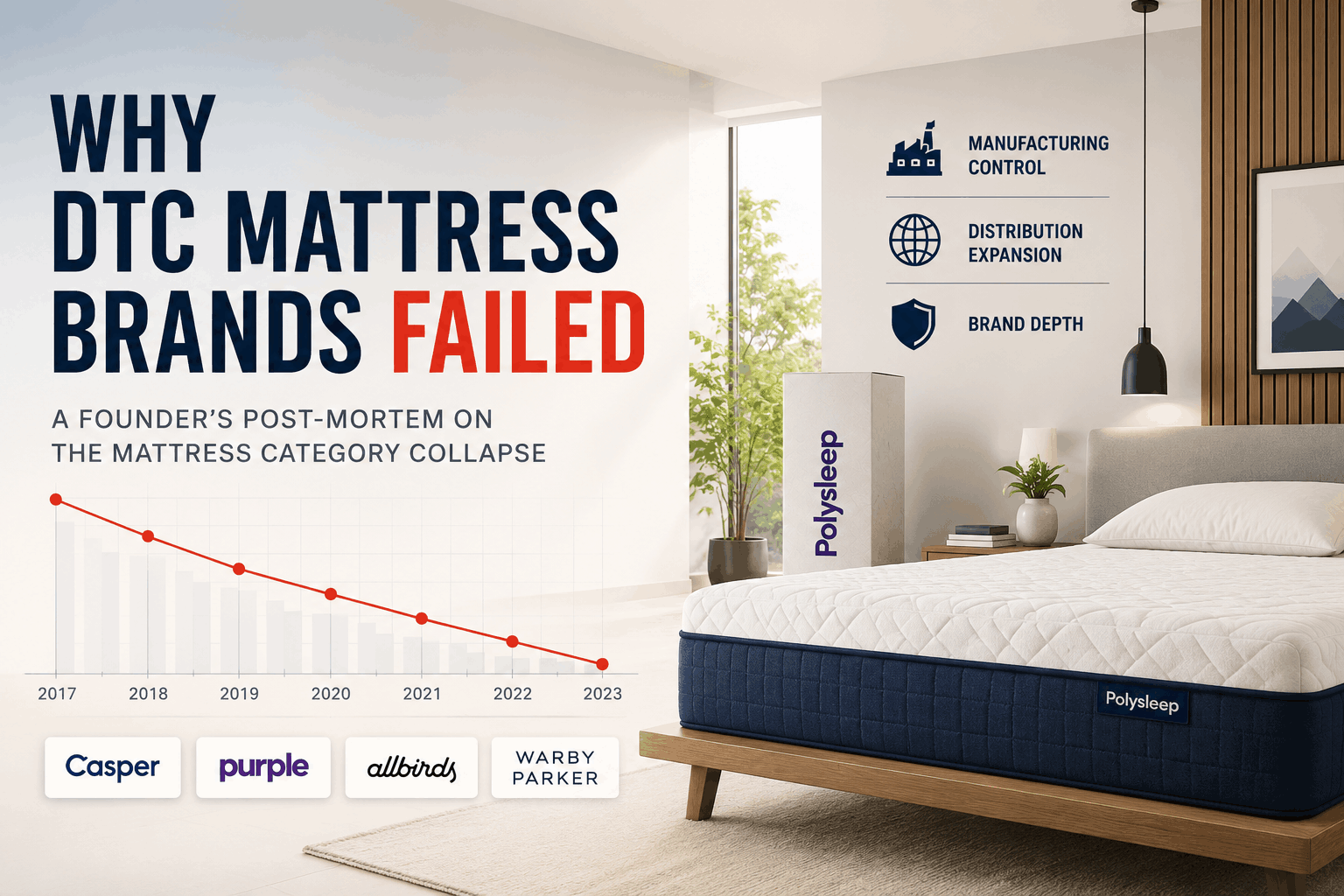
Casper's collapse wasn't an isolated failure. It exposed structural problems across the entire DTC mattress category. Here's what I saw from inside the industry while building Polysleep—and why we chose a different path.
Why DTC Mattress Brands Failed: A Founder’s Post-Mortem on the Mattress Category Collapse
The Casper Math
At its peak, Casper raised at roughly a $1.1 billion valuation. In 2022, it was taken private for about $309 million.
Those two numbers tell a more honest story than any investor deck from the period.
By the end of its public life, Casper might have lost less money handing every customer a free mattress and a few hundred dollars in cash than it did running the business the way it ran it.
That’s not hyperbole—look at the customer acquisition costs, contribution margins, fulfillment expenses, and overhead in the public filings between 2019 and 2021, and the economics get hard to defend.
The category was spending enormous capital to acquire customers it would never earn back, and Casper was just the largest, most visible version of a problem that had spread across the whole industry.

Why This Matters More Than Most People Think
The 2023 shakeout wasn’t a temporary correction. It was the inevitable end of a category that had spent nearly a decade misunderstanding its own economics.
Many first-generation DTC companies borrowed growth assumptions from software while running businesses that looked far more like traditional consumer brands. The brand-building worked. The financial model didn’t.
You can see the same arc in Casper, Purple, Allbirds, and Warby Parker.
Polysleep operated in the same window, sold through many of the same channels, competed for the same customers, and faced the same ad environment.
We didn’t share the outcome.
Looking back, I think the category broke for four reasons.
Cause #1 — CAC Inflation Broke the Model
The biggest misconception of the 2017–2021 DTC era was that founders could permanently outsmart Meta and Google.
Nobody can.
Mattresses had almost no barriers to entry. Manufacturing could be outsourced, a storefront could go live in weeks, and paid platforms were open to anyone.
The category got crowded fast. By 2019, there were more than 150 bed-in-a-box brands in the United States alone, most bidding on the same keywords, chasing the same audiences, and running nearly identical creative.
Every new entrant pushed acquisition costs higher while lifetime value (LTV) barely moved because nobody buys a second mattress for five to ten years.
When CAC doubles and LTV stays flat, the math eventually collapses—and no amount of optimization reverses it.
Cause #2 — The Data Goldmine Illusion
For a while, DTC brands rode a narrative that inflated their valuations.
These weren’t consumer brands, the story went—they were technology businesses sitting on valuable customer data.
That pitch pushed valuations far beyond traditional consumer multiples.
Casper raised at revenue multiples that looked like software.
Allbirds reached a public valuation near $4 billion.
Warby Parker entered the public markets around $6 billion.
But the underlying businesses never behaved like software.
They carried inventory, manufacturing, shipping, returns, and the margin constraints of physical products.
The capital structure assumed software outcomes while the companies remained consumer brands.
Eventually the market stopped believing the story.
It wasn’t a crash as much as a reclassification.
Investors simply remembered what these companies actually were.
Cause #3 — The Copycat Problem Nobody Talks About
This is the factor that gets the least attention.
When most participants in a category chase short-term gains instead of building a brand, the whole category pays.
Consumers don’t separate the good operators from the bad ones.
They judge the segment as a whole.
As hundreds of low-quality mattress brands flooded the market, sourcing similar overseas foam and competing almost entirely on price, “bed-in-a-box” stopped meaning convenience and started meaning cheap.
That shift punished the serious operators most.
Brands investing in product quality, customer experience, and operational excellence were forced to fight a category perception they hadn’t created.
The copycats poisoned the segment, and everyone paid for it.
Cause #4 — Most Brands Had Marketing, Not a Story
When consumers see 150 products that look identical, differentiation becomes everything.
Most mattress brands thought they had a story.
What they actually had was advertising.
Those aren’t the same thing.
A real story isn’t built by the marketing department.
It’s reinforced through product development, manufacturing decisions, customer support, delivery, warranties, and return policies.
Every department either strengthens the narrative or weakens it.
The brands that survived weren’t the loudest marketers.
They were the operators whose story lived inside the business itself.
Campaigns expire.
Operational identity compounds.
What Did Polysleep See That Others Didn’t?
While much of the Canadian category expanded horizontally, we went the other way.
Sleep Country acquired major competitors—including Endy, Silk & Snow, and Hush.
From a retail perspective, that made sense.
A bigger catalog creates more cross-sell opportunities, and pillows, sheets, bases, and frames help offset rising acquisition costs.
If you’re a retailer, it’s rational.
We weren’t trying to become a retailer.
We were building a brand, and following that playbook would have diluted what made us different.
So we focused on depth instead.
The conversations that led to deeper alignment with Domfoam started before the reset.
The logic was straightforward:
- More control over manufacturing quality
- Better operational leverage
- A stronger foundation than advertising alone could buy
At the same time, we wanted to meet customers wherever they actually encounter a mattress:
- Amazon
- Costco
- Airbnb units
- Hotels
- Retail floors
The goal was never to become the next Casper.
It was to become the cooler Tempur-Pedic.
The shakeout didn’t surprise us.
It confirmed a thesis we’d already committed to.

Is DTC Dead, or Just Changing?
The strongest counterargument is that DTC isn’t broken.
It’s cyclical.
There’s a reasonable case that today’s survivors generate exceptional returns over the next five years as capital markets become more favorable again.
I think there’s truth in that.
Consumer categories rarely disappear.
They evolve as technology changes, distribution shifts, and customer behavior changes.
The mistake is assuming either extreme.
The founders of 2019 assumed the boom would last forever.
Much of today’s commentary assumes the reset is permanent.
I don’t believe either view is right.
DTC will come back.
But the next generation of winners will operate under very different assumptions about capital, margins, and customer acquisition.
Most of the original players won’t be leading that cycle.
Monday Morning Takeaway
If you’re running a consumer business today, ask yourself three questions:
- Are your unit economics still attractive if acquisition costs rise another 30%?
- Is your capital structure aligned with the business you actually run, rather than the multiple you hope to get?
- Does your story live inside the operation itself, or only inside your advertising?
Those questions matter far more than market sentiment.
The companies that win the next cycle will answer them before the market forces them to.
Final Thought
If you’re an operator or investor trying to read where consumer categories go next, study the mattress industry closely.
It wasn’t an exception. It was an early warning.
If you’re an operator or investor reading the post-2023 consumer market, I take a small number of advisory engagements each year.
Reach out.
